| Smokey Rolls Down Thunder Canyon | 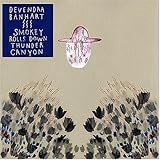
 enlarge enlarge | List Price: $14.98
Buy New: $9.43
You Save: $5.55 (37%)
Buy New/Used from $6.82
Avg. Customer Rating:   (based on 17 reviews) (based on 17 reviews)
Sales Rank: 7222
Category: Music
Artist: Devendra Banhart
Publisher: Xl Recordings
Studio: Xl Recordings
Manufacturer: Xl Recordings
Label: Xl Recordings
Media: Audio CD
Discs: 1
Shipping Weight (lbs): 0.2
Dimensions (in): 5.6 x 5 x 0.5
MPN: 40283
UPC: 634904028329
EAN: 0634904028329
ASIN: B000UGG33M
Release Date: September 25, 2007
Availability: Usually ships in 1-2 business days
|
| Tracks:
| • | Cristobal | | • | So Long Old Bean | | • | Samba Vexillographica | | • | Seahorse | | • | Bad Girl | | • | Seaside | | • | Shabop Shalom | | • | Tonada Yanomaminista | | • | Rosa | | • | Saved | | • | Lover | | • | Carmencita | | • | Other Woman, The | | • | Freely | | • | I Remember | | • | My Dearest Friend |
|
| Similar Items:
|
| Editorial Reviews:
Amazon.com
Recorded in Topanga Canyon in the Santa Monica mountains. Neil Young lived there while recording "After The Gold Rush" and the area has also been home to Emmylou Harris, Taj Mahal, Joni Mitchell, Mick Fleetwood, and members of The Doors. Those ghosts inhabit the sound and vibe of these recording sessions. Banhart's whole "freak folk" tag is gone, replaced with this classic, gorgeous rock album. Some songs are fragile and solipsistic, others have a pronounced tropicalia influence, and still others are wildly electric and epic. More from Devendra Banhart 
Cripple Crow | 
Rejoicing in the Hands | 
Nino Rojo |
|
| Customer Reviews: Read 12 more reviews...
musical pomo February 1, 2009
0 out of 1 found this review helpful
The advantage of working with younger generations is that they can turn you onto things you would not otherwise seek on your own. Such is the case with the music of Devendra Banhart: one of my students used to play a medley that, to my delight, included "Chinese Children" in class, and another sent me a couple of his CD's recently (Cripple Crow and Smokey Rolls Down Thunder Canyon). I slipped them (one at a time) into the CD player and took to them immediately. My husband, on the other hand, upon hearing Cripple Crow in the car, called it "derivative boring crap".
I know what it is that I like about these records; it's comfortable music. It shape shifts among a myriad of familiar genres that make up my musical consciousness and that, for the most part, I like: the receptors in my brain are already configured to respond to it. The following is a partial list of ingredients others have invoked to describe Banhart's music: Funk, Samba, Eisenhower-era doo-wop, Tropicalia, Reggae, Beatles, Tiny Tim, Caetano Veloso, David Crosby, Donovan, Santana, Nick Drake, Skip Spence, Jerry Garcia, Bob Dylan, Leonard Cohen, The Byrds, Conga, Groove, bossa nova, psychedelia, folk, and I definitely hear The Doors... One of the favorable reviews of "Smokey Rolls Down Thunder Canyon" on Amazon does say the CD "has something for everyone" with the assumption that that's a good thing. It obviously does nothing for my husband who likes a more assertive kind of music; and although I love listening to the albums, one of my favorite unfavorable reviews of Cripple Crow is: Este CD e espantosamente horrible... no tiene estilo proprio. I love the word "espantosamente" (scary); but it is the phrase "no tiene estilo proprio" (has no personal style)that interests me, and brings me back to Jean Baudrillard and the `80's.
Although I first learned about the word "bricolage" from my French uncle while he tinkered around the construction site that was to be his future house, if I recall correctly, it went from fun to theory with Derrida[1], and was quite in vogue during the 80's to describe what visual artists and writers were doing with their art and texts---or was everything just "text" then (?)... Baudrillard does not seem to use the word to describe the state of the arts in the 80's; but what he describes as being postmodern in his interview "Game with Vestiges" seems to fit under its definition (gestalt being what it is, of course it would). "Art can no longer operate as radical critique or deconstructive metaphor. So art at the moment is adrift in a kind of weightlessness. It has brought about a sphere where all forms can coexist. One can play in all possible ways, but no longer against each other. It amounts to this: art is losing its specificity. ...It is becoming mosaic... it cannot do anything more than operate out of a combinatory mode..... The postmodern is characteristic of a universe where there are no more definitions possible... It has all been done. The extreme limit of these possibilities has been reached. It has deconstructed its entire universe; so all that's left are pieces. All that remains to be done is to play with the pieces." Visual Art seems to have internalized and gotten past this; but could this be what Banhart is doing consciously or not?
By the 80's Baudriallard could sound melodramatic and nostalgic, and he seems to imply a sadness to this postmodern form of play: "Postmodernism tries to bring back all past cultures, to bring back everything that one has destroyed in joy and which one is reconstructing in sadness in order to try to live, to survive...". And although I see Banhart's music as quintessentially postmodern[2] and thus utterly digestible, I don't see it as a "reconstruction in sadness" but one that is done in "joy"; it remains to be seen where he can take it from here.
[1] Well it was first used by Claude Levi Strauss (if the memories of Anthro 101 serve me well); but it r-e-a-l-l-y got s-e-r-i-o-u-s after Derrida got adopted by the visual arts critical establishment. ...and then it disappeared...
[2] weightless, combinatory, and "bricolaged"
 very impressive production qualities December 23, 2008 very impressive production qualities December 23, 2008
I should start by saying I'm no expert on contemporary music. When it comes to new artists, I rely on friends to send music in my direction. A friend sent me this album for my birthday and I gave it a few listens without being much impressed and instead being a bit turned off by its whimsicalness. I started listening to it again after about 3 months of non-stop listening to Bon Iver's For Emma, Forever Ago. This time I was completely taken by the album. Banhart's range impressed me but more than that I was amazed at the perfect rendering of so many different styles. I mean, if you listen to the rock guitar in Sea Horse, you feel you could be listening to an outtake from Neil Young's After the Goldrush album. There are countless instances of Banhart perfectly rendering other musical styles and influences on this album. A friend encouraged me to buy Cripple Crow, which she said was better. I like it a lot but to my ears Smokey Rolls is a musically far more accomplished album. Then again, I think Nick Cave's No More Shall We Part is musically head and shoulders above the Boatman's Call, and I know that is a minority opinion.
I have no interest in pigeon-holing Banhart into any specific musical style/genre. I saw a video of him on youtube in which he presented lots of his favourite vinyl records. His respect for the artists was evident and in my opinion Smokey Rolls Down Thunder Canyon is an album which offers evidence of Banhart's very broad range of influences and in its masterful rendering of so many styles makes clear the depth of his respect for the artists who have influenced him.
 Derivative Dervish December 1, 2008 Derivative Dervish December 1, 2008
0 out of 1 found this review helpful
I bought this CD because of hype: pretty girlfirend break-up, People magazine, NYTimes ponderous review, etc. and got what I paid for, more hype.
This CD is too cute by far. None of it is original, all of it quotes the original without the courtesy of improving on it, and in the end is a boring mish-mash of an attempt to sound transformative. Oh, I forgot, this is the generation that prizes diversity over talent.
Think of Cat Stevens behind way too many qualuudes and you have an approximation of how important this voice wishes you to believe it is.
 A true letdown October 15, 2008 A true letdown October 15, 2008
1 out of 1 found this review helpful
"Smokey Rolls Down Thunder Canyon" is Devendra's most diverse release to date. Then how come it's so inferior to his previous work? Well, it seems like the long haired child lost his muse that led him through "Rejoicing in the Hands", "Nino Rojo" and "Cripple Crow". Most of the material here is pretty, but offers no real content. The production is the most puzzling yet for Devendra. Unlike the home recordings of "Oh Me Oh My" and crystal clear sound of "Nino Rojo" and "Rejoicing in the Hands", here we have what appears to be a 60s-influenced production style that tries to cover up for the lack of substance. The record went through extensive mixing and for the most part, Devendra's vocals are unrecognizable. Lyrically, it adds a nice touch to his collection with a handful of songs in Spanish. The record is instrumentally lush, but rather underwhelming.
From a fairly good opener "Cristobal" to the uninteresting closer "My Dearest Friend", "Smokey" is a mixed bag of songs varying in quality. In certain moments, Devendra seems to be digging through his catalogue, recycling his melodies and relying too much on the production techniques. "Samba Vexillographica" has a guitar melody reminiscent of "Santa Maria De Feira" and "Long Haired Child" seems to have a descendant in "Lover". Other times, vocal harmonies are here to hide the fact that very little is offered on this album. When the intimacy of his earlier work appears on "Canyon", it is wasted on lifeless songs such as "Sea Side" and "Freely". Many songs were written for the piano, an instrument Banhart isn't very capable with. The material is bland and calmness soon becomes lethargy.
"Sea Horse" whirls around trying to find a structure. The first two minutes are completely empty until Devendra adopts a catchy piano melody and soon adds an electric guitar. However, it serves as a proof of his self-indulgence, clocking in at eight minutes. "Bad Girl" is an exemplary track for the record: it is pretty, but leaves the listener feeling nothing. "Saved" is a cliched track with its slow beat, backing vocals and an unpleasant melody on organ. "Lover" tries to bring some life into the record, but fails as it ends abruptly. Apart from its chorus and strings, "Freely" is rather flaccid. The record ends with "I Remember" and "My Dearest Friend", both equally weak.
There is some good material to be found on "Smokey Rolls Down Thunder Canyon". "Rosa" actually benefits from the calm atmosphere and simplistic piano playing and grows on the listener with frequent listens. "Shabop Shalom" actually manages to be interesting. After a spoken word intro, it brings some life into the record with a nice beat and a great piano melody. The record continues strongly with "Tonada Yanomaminista". The tension in "Carmensita" is almost unbearable and it is easily one of the highlights. Things get even better in "The Other Woman", a reggae track that shows how vocally brilliant a Devendra song can be.
"Smokey Rolls Down Thunder Canyon" shows how essentially flawed Banhart's work is and makes one doubt that he'll ever grow into a good musician. If you are interested in exploring Devendra's works, I highly recommend "Cripple Crow" as it easily outshines everything else he did. "Smokey" was most probably intended for people who coped well with plain material on Devednra's previous works. It does not make for a good listening experience and it is best to keep hoping that one day, Banhart will second-guess himself and his music and make a truly exceptional piece of art. The chances are quite thin, but no one can benefit from pessimism, right?
I'll roll down Thunder Canyon with Smokey for the rest of my life! June 6, 2008
1 out of 2 found this review helpful
I would've never thought that Devendra Banhart would go and record one of my all-time favorite albums / cd's. I originally bought Rejoicing In The Hands and didn't really care that much for it (I sold it), but Smokey Rolls Down Thunder Canyon is an entirely different matter. This one is a timeless beauty - a modern classic. I am never going to tire of these wonderful songs - I already know this for sure. Honorable mention goes to Seahorse, Bad Girl (my favorite song here) and Freely, which reminds me a little of the J.J. Cale classic Magnolia.
But all the songs are wonderful, each in their own way. Highly recommended!
|
|
|
